
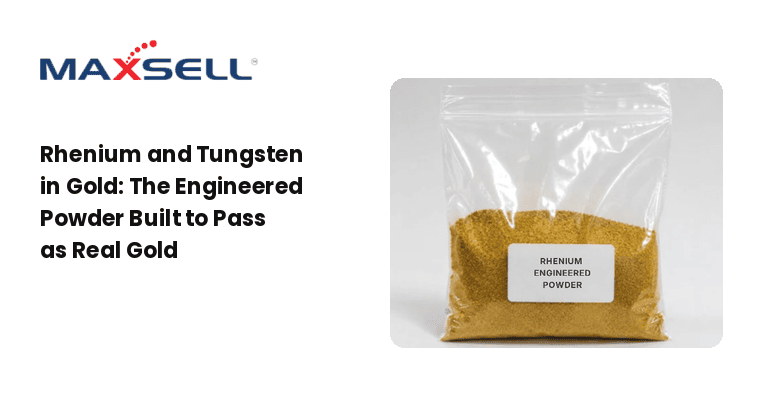
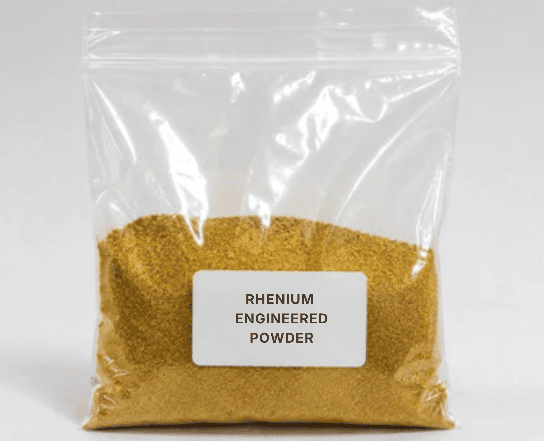
The so-called “rhenium powder” being used to adulterate gold is not plain rhenium. It is a specially engineered powder, with rhenium as one of its components, processed so that the entire powder looks like gold. Added to a melt, it raises the weight of the ornament while keeping the colour, shine and feel of genuine gold. Visual checks, touchstone, density tests and conventional XRF set-ups can all pass it. The fraud can come to light only at the refinery, after the gold is melted and dissolved in aqua regia, and by then the loss has already moved down the chain of buyers, dealers and lenders. For Indian jewellers, gold loan lenders, karigars and refiners, it is now a fraud that has to be screened for at the counter.
Not “Rhenium Powder”: An Engineered Powder Made to Look Like Gold
Most market talk calls it “rhenium powder”, and that label misleads buyers. Plain rhenium and tungsten are silvery-grey metals. Mixed into gold as raw powders, they would leave grey or dull spots that an experienced eye could catch.
The powder used in this fraud is built to avoid exactly that. It is a combination of heavy metals, with rhenium as a key component, processed through a high-tech method so the whole powder carries a golden finish. There are no grey spots and no visible flaws. The finished ornament, coin or bar looks like normal 22K or 24K gold.
That is the catch that makes this fraud work. The powder is designed from the start to look like gold, weigh like gold and read like gold on conventional XRF. Its only purpose is to add cheap weight that the buyer pays for at gold rates.
Why It Weighs Like Gold
Its heavy-metal base matches gold where a buyer checks next: weight.
| Metal | Density (g/cm³) | Melting point |
|---|---|---|
| Gold | 19.32 | 1,064°C |
| Tungsten | 19.25 | 3,422°C |
| Rhenium | 21.02 | 3,186°C |
Tungsten is almost exactly as heavy as gold, and rhenium is slightly heavier. Both cost far less than gold, so every gram added is paid for at gold rates. They also melt far above gold’s temperature, so they do not dissolve in a normal melt. They stay as particles spread unevenly through the metal, which means a test at one spot can read clean while another spot is contaminated.
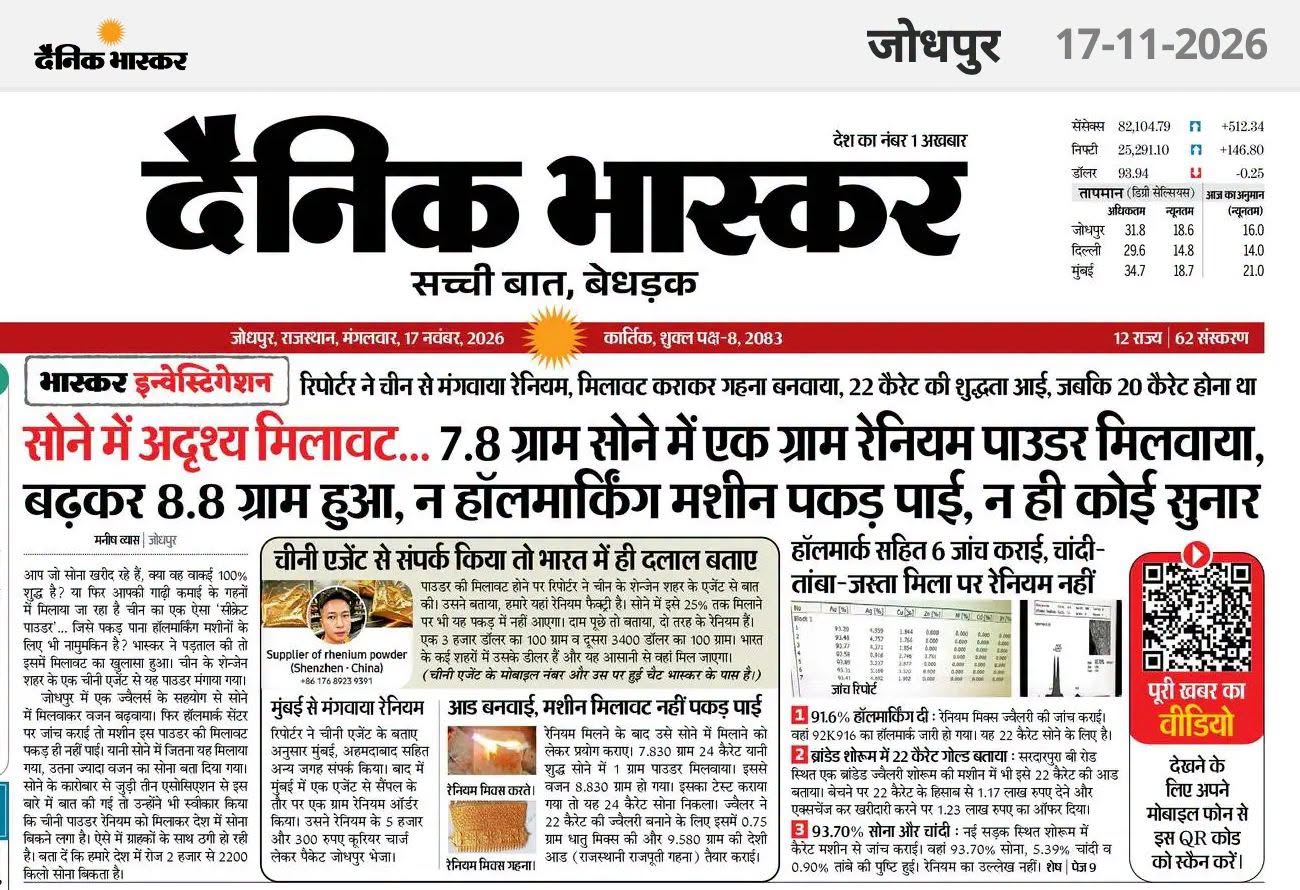
The Jodhpur Case: “Rhenium” Gold Passed a 22K Hallmark
In November 2026, a Dainik Bhaskar investigation worked with a Jodhpur jeweller to mix 1 gram of the powder sold in the market as “rhenium powder” into 7.830 grams of 24-carat gold, then added 0.75 gram of another alloying metal to bring it to 22 carats. The finished ornament weighed 9.58 grams and looked like any other gold piece. A hallmarking centre reportedly gave it a 22-carat (22K916) hallmark. A showroom machine read it as 93.70% gold, 5.39% silver and 0.90% copper, with no rhenium reported.
Based on the gold actually used (7.83 grams in a 9.58 gram ornament), it held only about 81.7% gold, closer to 20 carats. Business Standard put the buyer’s loss at about ₹14,700 per tola.
The powder was traced to a supplier in Shenzhen, China, through a Mumbai-based agent. The investigation’s claims about where the powder comes from and how widely it circulates have not been independently established.
Related warnings came earlier. A Mint report cited complaints from artisans in Indore’s Sarafa market about ruthenium, iridium and osmium adulteration. In 2017, MMTC-PAMP told an LBMA conference that adulteration with iridium, ruthenium and osmium was rampant in India’s unorganised sector. Oversight is also stretched: a CAG draft audit reportedly found BIS fell about 43.7% short of its surveillance targets for hallmarking centres (2,194 of 5,020 planned audits missed between 2020-21 and 2024-25).
How Rhenium and Tungsten Get Into Gold
Deliberate mixing to add weight
Most cases are deliberate. The engineered powder is melted into gold to add cheap weight without changing its colour. Tungsten also goes in as a solid core wrapped in a gold shell inside bars and coins. Gold recycling buyers have reported “999 scrap” that carries both metals together.
Old jewellery and recycled scrap
Not every heavy impurity is fraud. Rhenium, tungsten, iridium, ruthenium and osmium also come from industrial and older alloys that enter the scrap stream. Small deliberate additions of iridium and ruthenium (typically 0.01 to 0.1%) are also used as grain refiners in genuine jewellery alloys, so a trace is not proof of fraud. After a few remelts nobody can trace them, and old gold exchange counters carry that risk. But this aspect is rare and almost invisible in the market traces.
Why Common Gold Tests Miss Rhenium and Tungsten
Visual check
The powder is made to look golden, so there are no grey spots or dull patches to see. Even experienced eyes find nothing wrong.
Touchstone and acid tests
These tests judge purity by how the surface reacts to acid. The adulterated piece still contains a large share of real gold, and the powder’s golden finish streaks like gold on the stone. The piece passes.
Specific gravity test
Because tungsten and rhenium are as heavy as gold, the density reading barely moves. A water displacement test passes the piece as genuine.
Fire assay and refining
Fire assay is the reference method for gold purity, but the small drilled sample can miss scattered particles. In practice, the fraud can be discovered only when the gold is melted and refined through the aqua regia process, where the heavy metals separate out. By that stage the piece has passed through several hands, and each buyer in the chain has paid gold rates for metal that was never gold.
Conventional XRF machines
XRF identifies each metal by its X-ray signal. Rhenium and tungsten give off signals very close to gold’s own, in the 8 to 10 keV range, and the engineered powder is designed to take advantage of this. A conventional machine whose element list and calibration do not account for them can read that signal as gold, or ignore it and rescale the remaining elements to 100%. Either way it reports a clean, high purity. That is one likely reason the Jodhpur showroom machine showed 93.70% gold, 5.39% silver and 0.90% copper, and nothing else.
What Rhenium and Tungsten Cost Indian Gold Businesses
- Jewellers running old gold exchange: You pay 22-carat rates for metal that may be 20 carats or lower. The loss shows up only when the lot is melted or refined.
- Gold loan NBFCs, banks and co-operative societies: Loans are sanctioned against overstated purity. If the borrower defaults, the collateral is worth less than the loan.
- Pawnbrokers and small lenders: One adulterated piece can wipe out the profit on many good ones.
- Manufacturers and karigars: Undissolved particles can cause hard spots and cracks during rolling and wire drawing, often noticed only late in production.
- Refiners: You are often the first to find the powder, during aqua regia refining, after every buyer before you has already paid gold rates for it.
- Hallmarking centres: One adulterated piece that gets a hallmark damages trust in the whole system.
How Advanced XRF Detects the Engineered Powder
Because the powder is built to read as gold, catching it takes more than a good detector. It needs an analyser designed around how this powder behaves. These are the features and habits that make the difference.
- Semiconductor detector. A Si-PIN or SDD detector gives the resolution needed to start separating the rhenium and tungsten lines from gold’s, and an SDD does it more cleanly at low percentages. Older proportional counter machines cannot.
- Dedicated detection logic. Listing Re and W in the element library is not enough on its own. The software must be built to recognise the signature of this engineered powder. It should also include germanium, so hard gold pieces are not falsely flagged.
- Multi-point testing. Particles are uneven. Test three to five spots, including clasps, joints and the inside surface.
- A firm red flag rule. If Re or W appears above the trace level your process sets, stop the transaction. Re-test at several points and on a second instrument. Then, only with the owner’s written consent, send the piece to a recognised lab or refinery for assay before you pay or lend. If the owner refuses, decline.
- Ultrasound for bars and coins. XRF reads only the top few microns of metal. Pair it with ultrasonic testing to catch tungsten cores.
- Tight counter rules. Be cautious with “999 scrap” offered below market rate. Do not rely on appearance: this gold looks clean by design. Save a test report with photos, and the HUID where the piece has one, for every purchase and loan.
How Maxsell Detects It
Through rigorous R&D, Maxsell studied the structure of this powder and how it behaves inside gold, and built detection specifically for it. Maxsell gold testing machines running software version or later carry this function. Aurum 6, Maxsell’s advanced XRF gold testing machine for jewellery counters and gold loan branches across India. Its key features:
- Rhenium and tungsten detection warning, built on Maxsell’s R&D into the engineered powder, that alerts the operator the moment it shows up.
- Si-PIN semiconductor detector covering a wide element range up to uranium, which includes rhenium and tungsten.
- Element list including Au, Ag, Cu, Cd, Zn, Ni, Ir, Ru, Rh, Os and Re, among 30+ elements.
- Gold plating alert to catch plated pieces.
- Fast results with testing time selectable from 10 to 60 seconds.
- Non-destructive testing. No scratching, no acid, no cutting. Customers can watch the test through the transparent chamber.
- HUID support and branded reports that can be shared on WhatsApp, giving you a record for every transaction.
- AERB approved for use in India.
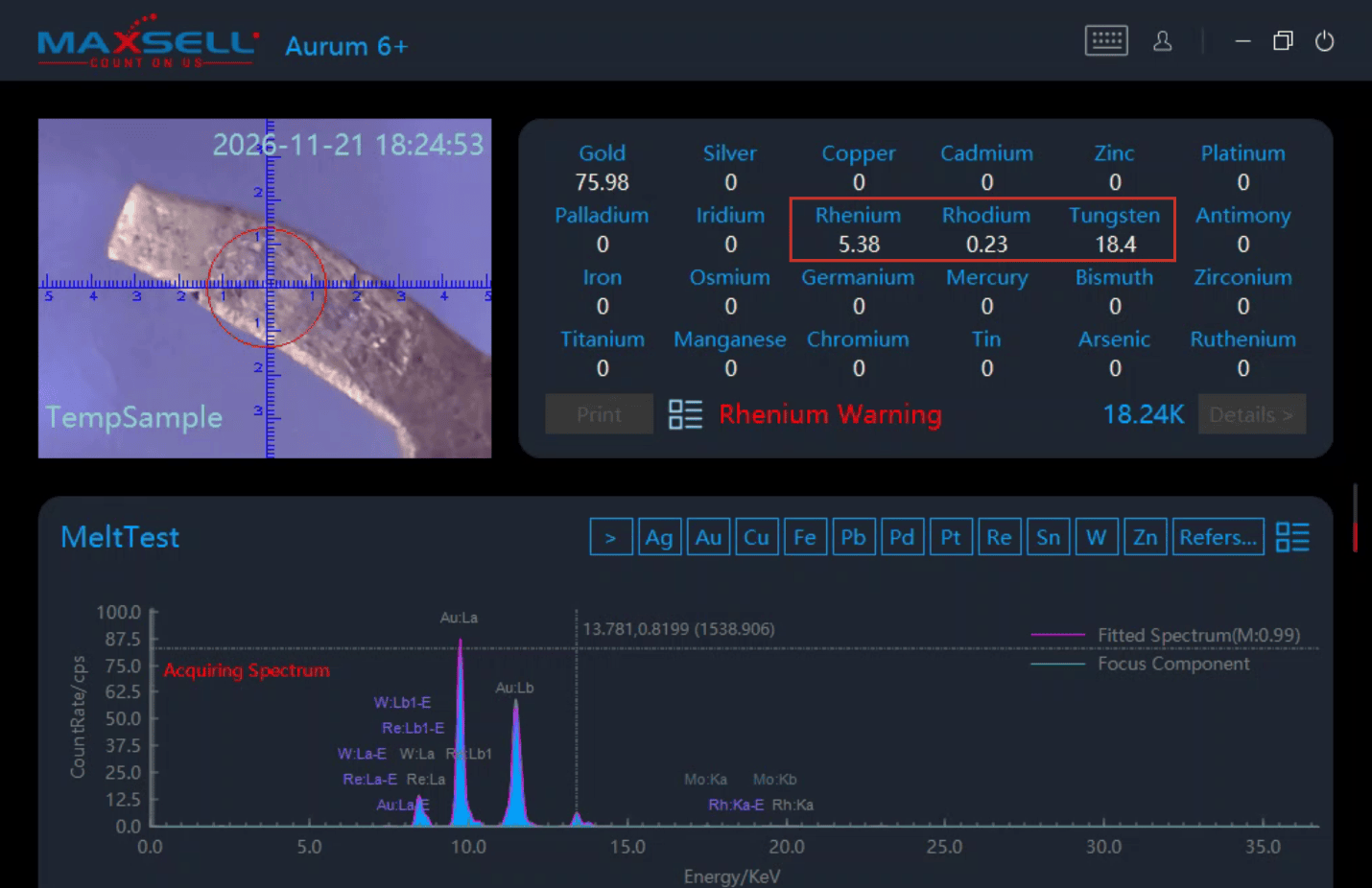
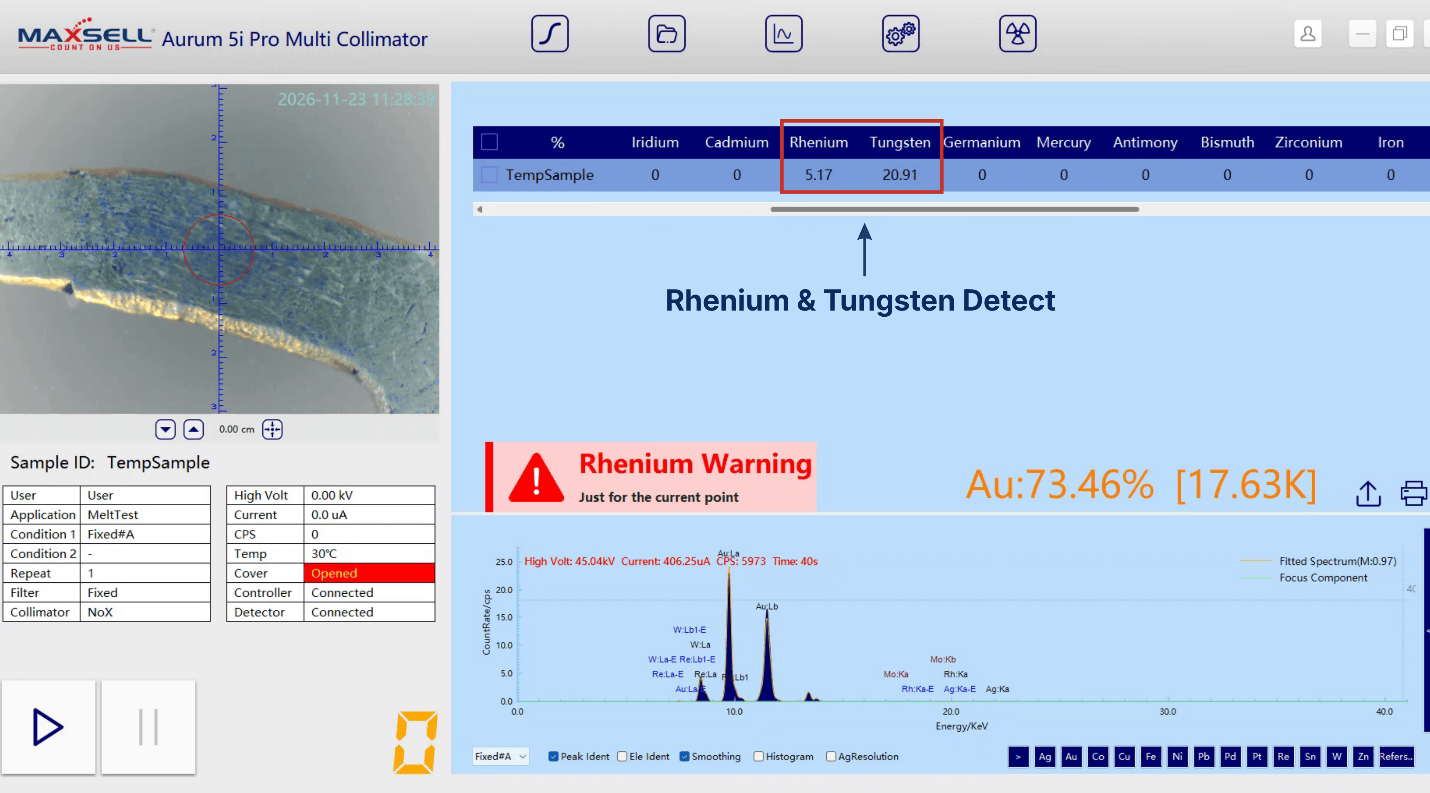
Using a Maxsell analyser bought before 2024? Eligible models can be upgraded with this detection function free of charge. Contact Maxsell Customer Care or your dealer to confirm your model and schedule the upgrade, so your counter is ready before a doubtful piece arrives and you avoid a costly mistake.
For jewellers buying old gold, Aurum 6 screens every piece in seconds before money changes hands. For gold loan NBFCs, banks and pawnbrokers, it adds a documented purity check to every loan file. For refiners, manufacturers and hallmarking centres, it flags suspicious lots before they enter production. High-volume labs and refiners can also choose the Aurum5i FSDD Pro, which uses an SDD detector.
Aurum 6 works best as part of a clear process: multi-point testing, a firm rule for what happens when the powder is flagged, and ultrasound or assay for bars and doubtful melts.
Bring your most doubtful old gold and test it on Aurum 6. Book a free demo with Maxsell at your shop or branch, or ask whether your older Maxsell machine is eligible for the free upgrade.
Book a Demo | Call +91-7338712224 | info@maxsell.co.in
Frequently Asked Questions
Why does gold mixed with this powder look real?
Because the powder is engineered to look like gold. Rhenium is one of its components, and the whole powder is processed to carry a golden finish, so no grey spots appear. Its weight also stays close to pure gold.
Is it just rhenium powder mixed into gold?
No. “Rhenium powder” is a common misunderstanding. It is a special engineered powder in which rhenium is one component, made to increase the weight of the gold and cheat the buyer.
Is rhenium and tungsten adulterated gold being sold in India?
It has been reported. A November 2026 Dainik Bhaskar investigation in Jodhpur mixed powder sourced from China into gold, and the ornament reportedly received a 22-carat hallmark. How widely it circulates has not been independently established. Separately, artisans in Indore have reported iridium, ruthenium and osmium adulteration.
Can a touchstone or acid test detect rhenium and tungsten in gold?
Usually not. The piece still contains enough real gold, and the powder’s golden finish streaks like gold on the stone.
Can a specific gravity test catch tungsten in gold?
No. Tungsten’s density (19.25 g/cm³) is almost the same as gold’s (19.32 g/cm³), so the reading barely changes.
Can an XRF gold testing machine detect rhenium and tungsten?
Not reliably with a conventional set-up, because the powder is designed to read as gold. Detecting it needs a semiconductor detector, software built to recognise this specific powder, and testing at several points.
Which Maxsell gold testing machines can detect rhenium and tungsten?
Maxsell gold testing machines running software version or later detect it. Eligible older Maxsell instruments can be upgraded with the function free of charge. Aurum 6 suits jewellery counters and gold loan branches, while the Aurum5i FSDD Pro suits refiners and high-volume labs.
Does a BIS hallmark guarantee there is no rhenium or tungsten?
A hallmark is strong protection, but the Jodhpur case shows adulterated gold can slip through. Jewellers and lenders should test old gold themselves before buying or lending against it.
When is this fraud discovered?
Sometimes only at refining, when the gold is melted and processed in aqua regia. By then the loss has passed through the chain of dealers. Testing at the counter, before money changes hands, is the way to stop it early.
What should a gold loan company do if XRF shows rhenium or tungsten?
Pause the loan, save the test report, re-test at several points and on a second instrument, and assign no value until the piece is verified. Any cutting, melting or lab assay should happen only with the borrower’s written consent and in the borrower’s presence. If the borrower declines, decline the loan.