
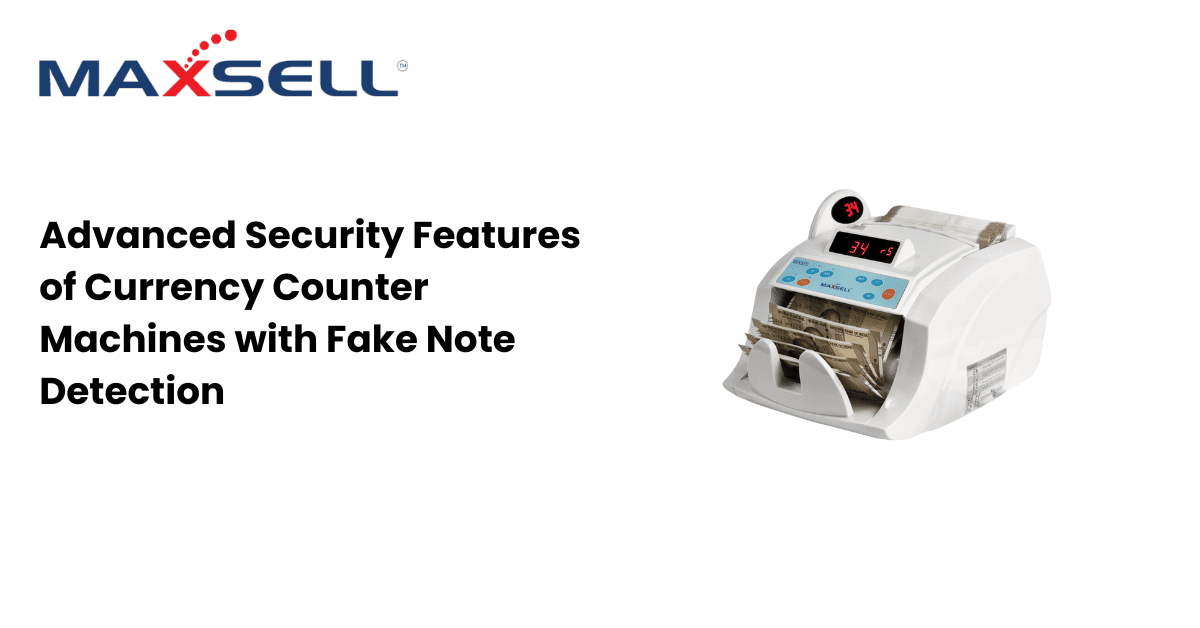
Precision and security are guaranteed, given the rapid pace at which transactional activities are taking place today, financially speaking. Daily, organisations, banks, as well as other retailers, handle vast amounts of money, making it crucial to ensure that every bill is a real one. It is here that the Currency Counting machine comes into its own, blending quick counting, accuracy and advanced detection technologies to offer a powerful solution against counterfeit money, far beyond mere counting functions.
The Evolution of Currency Counting Machines
The aim of the traditional money counters was solely to count money quickly, hence reducing human error and manual labour. The need for smarter machines arose with the complexity of money-counterfeit schemes. Presently, a Currency Counting machine has the capability to identify a fake bill immediately due to advanced sensors and intelligent algorithms incorporated into the system.
The devices examine the quality, value, as well as authenticity, apart from the rapid calculation of thousands of banknotes per minute. It is due to their dual functions that they are so useful in sectors involving extensive handling of money, which often demands accuracy.
Multi-Layered Counterfeit Letter Recognition
The strongest characteristic of a Currency Counting machine is its ability to pick out fake money through a number of verification processes. Each bill passes through a series of sensors designed to check the bill’s optical and physical features.
- Ultraviolet (UV) Detection: A real banknote will show signs that glow when exposed to UV light. A banknote that is not standard will be identified by the machine, which will scan for a particular set of patterns.
- Magnetic (MG) Detection: Magnetic ink or magnetic threads are embedded in the paper, commonly seen in various countries’ banknotes. The features are identified by magnetic sensors, ensuring authenticity.
- Infrared (IR) Detection: The infrared sensor looks at the reflective properties and hidden patterns that are characteristic only to actual bills.
- Image Recognition: High-quality images are captured by specialised high-resolution cameras to accurately photograph the note, which is then compared with stored templates, ascertaining the face value and authenticity of the bill.
- Size and Thickness Identification: The size and thickness of the fake bills often differ by a slight margin. The detection of anomalies involves measurement by a machine.
Alerts and Reporting in Real Time
The computer immediately pauses the count and identifies the note for physical analysis as soon as a suspicious note is detected. Some versions even have the capacity to create fake information, so that users can keep trends and report any incidents to the concerned authorities. The involvement of human error will, therefore, be minimal, as our actual time alert system is guaranteed to ensure security in all transactions.
Additionally, a number of modern machines now come with networking capabilities, as well as electronic displays that make record-keeping easy by relating to accounting systems.
Durability & Friendliness
Despite their advanced technology, modern Currency Counting machines are designed to be easy to use and robust. The machines are designed to be easy to operate, with features like touchscreens and self-cleaning systems, making them usable by all users. The machines are designed to be durable and can handle a busy operating environment, which may include banks, retail outlets and even casinos.
Conclusion
Spending money on a quality Currency Counting machine goes beyond just operational optimisation, as the inherent purpose lies in building trust, accuracy and financial integrity. Maxsell continues to be at the vanguard with its innovative cash handling solutions that combine accuracy, rapid processing and secure systems, helping organisations keep pace with the fight against counterfeits.
