
He asks a simple question:
“How much gold is really in this?”
Thirty years ago, most jewellers would have reached for a touchstone.
Fifteen years ago, many would have used a pocket gold tester.
Today, increasingly, jewellers place the ornament inside an XRF Gold Analyzer and receive a detailed report within seconds.
The interesting part?
All three methods are still used today. But they are not equal.
Each method was developed for a different era, a different level of risk, and a different level of confidence.
So which gold testing method is right for you? Let’s start from the beginning.
The Journey of Gold Testing: From Experience to Science
Gold has been traded for thousands of years. For most of history, testing gold relied heavily on human judgement and experience.
As the value of transactions increased and jewellery became more sophisticated, traditional methods started showing limitations.
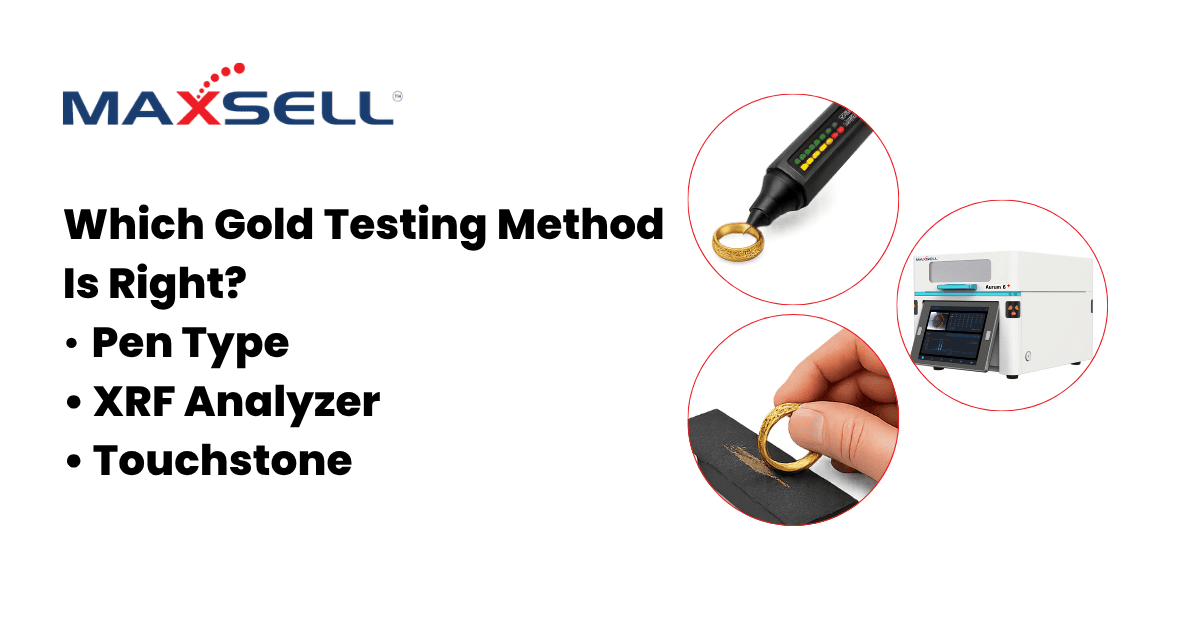
This led to three major approaches used today:
- Touchstone Testing — The traditional jeweller’s method.
- Pocket or Pen Type Gold Testers — Portable electronic screening devices.
- XRF Gold Testing Machines — Advanced scientific instruments used worldwide by professional precious metal businesses.
Each method represents a different stage in the evolution of gold testing.
Comparison at a Glance
| Feature | Touchstone | Pen Type Gold Tester | XRF Gold Analyzer |
|---|---|---|---|
| Testing Time | 1–3 Minutes | Seconds | 10–30 Seconds |
| Non-Destructive | Partially | Yes | Yes |
| Requires Chemicals | Yes | No | No |
| Operator Dependency | High | Medium | Low |
| Exact Metal Composition | No | No | Yes |
| Digital Report | No | No | Yes |
| Detects Alloying Elements | No | Limited | Yes |
| Suitable for Professional Buying | Limited | Moderate | Excellent |
| Suitable for Hallmarking & Labs | No | No | Yes |
Method 1: Touchstone Testing – The Traditional Approach
The touchstone method has served jewellers for centuries. The process is simple.
The jewellery is rubbed against a testing stone, leaving a metal streak. Different acid solutions are then applied to compare reactions.
Advantages
- Low cost
- No electronics required
- Widely understood
- Useful for basic verification
Limitations
- Relies heavily on operator experience
- Slightly invasive
- Tests primarily the surface
- No digital documentation
- Difficult to identify sophisticated alloy manipulation
A touchstone remains a useful screening tool, but in today’s environment where a single transaction may involve lakhs of rupees, many businesses require greater certainty.
Method 2: Pocket or Pen Type Gold Tester
As technology advanced, portable electronic gold testers became popular among travelling buyers, pawn brokers, and small jewellery businesses.
These devices typically assess electrical conductivity or resistance characteristics of the metal surface and estimate purity levels.
Advantages
- Portable and lightweight
- Fast testing
- Easy to use
- No chemicals required
Limitations
- Surface-level analysis
- Cannot provide full elemental composition
- Sensitive to contamination and contact quality
- Limited ability to identify hidden metals
Think of a pen tester as a quick screening device. It can help identify suspicious items, but it generally cannot provide the level of confidence required for high-value purchasing decisions.
Method 3: XRF Gold Analyzer – The Scientific Revolution
The real transformation in precious metal testing arrived with X-Ray Fluorescence technology, commonly known as XRF.
Unlike touchstones or conductivity-based testers, XRF does not estimate purity. It directly measures the elements present in the sample.
The analyzer bombards the sample with X-rays and measures the unique fluorescent signature emitted by each element.
Within seconds, the system can reveal:
- Gold (Au)
- Silver (Ag)
- Copper (Cu)
- Nickel (Ni)
- Zinc (Zn)
- Platinum (Pt)
- Palladium (Pd)
- And many other elements
Instead of saying “This looks like 22K gold,” an XRF analyzer can report:
“Gold: 91.6%, Silver: 5.1%, Copper: 3.0%, Others: 0.3%.”
That level of detail fundamentally changes the decision-making process.
Advantages
- Non-destructive testing
- Full elemental composition in seconds
- Digital report generation
- Low operator dependency
- Suitable for hallmarking and professional buying
Limitations
- Higher upfront investment
- Requires a fixed or semi-fixed setup
- Not suitable for field use
Why Has the World Moved Toward XRF?
The rise of XRF was not driven by marketing. It was driven by trust.
Over the past two decades, jewellery retailers, refiners, manufacturers, hallmarking centres, bullion traders, and financial institutions across the world have increasingly adopted XRF technology because it reduces uncertainty.
Today, XRF analyzers are routinely used across the United States, India, Europe, the Middle East, China, Southeast Asia, and Australia.
In many organisations, millions of dollars worth of precious metal transactions are verified using XRF analysis every day.
Businesses wanted faster testing, better repeatability, digital records, reduced human interpretation, consistent decision making, and greater transparency.
When multiple branches, operators, and locations are involved, businesses need results that are repeatable and defensible. XRF delivers exactly that.
Accuracy Comparison: Gold Testing Confidence Scale
| Method | Confidence Level |
|---|---|
| XRF Gold Analyzer | Very High |
| Pen Type Gold Tester | Moderate |
| Touchstone Testing | Moderate to Low |
The difference becomes increasingly important when buying old gold, testing high-value jewellery, verifying bullion, conducting quality control, or handling customer disputes.
Which Gold Testing Method Should You Choose?
Touchstone Testing
Best for traditional jewellers, basic screening, and low-budget operations.
Pocket or Pen Type Gold Tester
Best for travelling buyers, field inspections, and quick preliminary checks.
XRF Gold Analyzer
Best for jewellery retailers, gold buying centres, hallmarking centres, manufacturers, bullion traders, refineries, and any professional precious metal testing environment.
Final Verdict
Touchstones built the jewellery trade. Pocket gold testers introduced convenience. But XRF transformed gold testing from an art into a science.
As precious metal transactions became larger, customer expectations increased, and compliance requirements evolved, businesses needed more than estimates. They needed evidence.
That is why XRF has become the preferred technology across the global jewellery industry.
If your goal is quick screening, a pen-type tester may be sufficient.
If your goal is confidence, documentation, transparency, and detailed elemental analysis, an XRF Gold Analyzer remains the benchmark against which every other testing method is measured.
Because when the value of the transaction rises, confidence in the result becomes everything.