
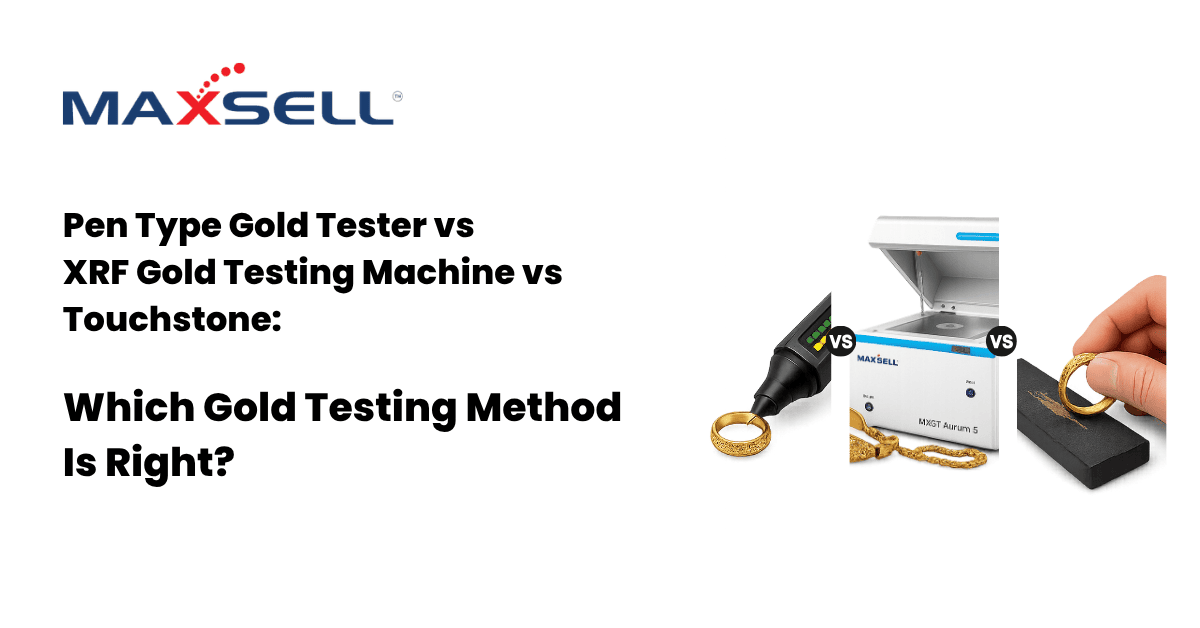
The third places the chain inside an XRF Gold Testing Machine.
Within a few minutes, all three may arrive at different conclusions.
So who is right?
The answer depends on what exactly needs to be tested, how much risk is involved, and how accurate the result must be.
Today, gold testing methods range from centuries-old touchstone techniques to advanced XRF spectroscopy used by refineries, hallmarking centres, manufacturers, bullion traders, banks, and jewellery retailers across the world.
Let’s compare the three most common methods and understand where each one fits.
The Evolution of Gold Testing
Gold testing has evolved significantly over the past few decades.
Stage 1: Touchstone Testing
For centuries, jewellers relied on touchstones and acid solutions. The process involved rubbing the jewellery on a stone, applying testing acids, and comparing colour reactions.
Stage 2: Pocket or Pen Type Gold Testers
Electronic gold testers introduced portability and speed. A handheld probe could provide a quick indication of gold purity without the use of acid.
Stage 3: XRF Gold Testing Machines
Modern XRF (X-Ray Fluorescence) analyzers transformed gold testing by providing detailed elemental composition within seconds.
Today, XRF technology is widely used in:
- Jewellery retail chains
- Hallmarking centres
- Precious metal laboratories
- Refineries
- Gold manufacturers
- Pawn brokers
- Bullion traders
- Banking and financial institutions
The reason is simple: businesses increasingly require objective, repeatable, and documented test results.
Quick Comparison Table
| Feature | Touchstone Test | Pocket / Pen Type Gold Tester | XRF Gold Testing Machine |
|---|---|---|---|
| Testing Method | Acid reaction | Electrical conductivity | X-Ray Fluorescence |
| Non-Destructive | No | Mostly Yes | Yes |
| Operator Skill Required | High | Medium | Low |
| Measures Exact Composition | No | No | Yes |
| Detects Hidden Metals | No | Limited | Yes |
| Digital Report | No | No | Yes |
| Repeatability | Moderate | Moderate | Very High |
| Suitable for Retail Screening | Yes | Yes | Yes |
| Suitable for Professional Verification | Limited | Limited | Excellent |
| Suitable for Hallmarking / Labs | No | No | Yes |
Method 1: Touchstone Testing
The touchstone method remains one of the oldest gold testing techniques.
How It Works
- Jewellery is rubbed against a testing stone.
- Acid solutions of known strengths are applied.
- Colour changes are compared visually.
Advantages
- Low cost
- Easy availability
- No electricity required
- Useful for basic field testing
Limitations
- Slightly destructive
- Depends heavily on operator experience
- Surface-only assessment
- Difficult to identify sophisticated alloy manipulation
- No digital documentation
The biggest challenge is that the result depends largely on the judgement of the person conducting the test. Two operators may interpret the same result differently.
Method 2: Pocket Type or Pen Type Gold Tester
Pocket gold testers became popular because they offer quick testing without acids.
How They Work
Most electronic testers evaluate conductivity or resistance characteristics of the metal surface. Based on these readings, the device estimates purity ranges.
Advantages
- Portable
- Fast testing
- Minimal training required
- Convenient for field buyers
Limitations
- Primarily surface testing
- Sensitive to contamination
- Accuracy varies based on contact quality
- Limited ability to identify complex alloy compositions
- Cannot provide full elemental analysis
For many small buyers, a pen tester serves as a useful screening tool. However, it should not be considered a replacement for laboratory-grade analysis.
Method 3: XRF Gold Testing Machines
XRF stands for X-Ray Fluorescence. Rather than guessing purity based on colour reactions or conductivity, XRF directly measures the elemental composition of the sample.
How It Works
The instrument directs X-rays onto the sample. The elements present emit characteristic fluorescent signals. The analyzer then calculates the concentration of gold, silver, copper, nickel, zinc, platinum, and many other elements. Results are generated within seconds.
What Makes XRF Different?
Instead of asking “Does this appear to be 22K gold?” XRF answers:
“This sample contains 91.6% Gold, 5.2% Silver, 2.4% Copper and 0.8% other elements.”
That level of information changes everything.
Why Has XRF Become the Global Standard?
Over the last 25 years, XRF technology has become one of the most trusted precious metal testing methods worldwide.
Today, thousands of jewellery businesses, assay laboratories, refiners and hallmarking facilities depend on XRF analyzers for daily decision-making.
The shift happened because businesses wanted:
- Faster testing
- Better repeatability
- Non-destructive analysis
- Digital reporting
- Reduced human interpretation
- Greater transparency
In many professional environments, decisions involving lakhs or crores of rupees are often based on XRF analysis because consistency matters.
When multiple branches, operators, and locations are involved, businesses need a system that produces the same result repeatedly under controlled conditions.
Which Method Is Most Accurate?
General Accuracy Ranking
- XRF Gold Testing Machine
- Pocket / Pen Type Gold Tester
- Touchstone Testing
However, accuracy should not be viewed alone. The better question is: which method is right for your business?
Which Method Is Right for Your Business?
| User Type | Recommended Method |
|---|---|
| Small travelling buyer | Pen Type Tester |
| Casual verification | Touchstone or Pen Tester |
| Jewellery Retail Store | XRF Analyzer |
| Gold Buying Centre | XRF Analyzer |
| Hallmarking Centre | XRF Analyzer |
| Manufacturer | XRF Analyzer |
| Bullion Trader | XRF Analyzer |
| Refinery | XRF Analyzer |
Frequently Asked Questions
Can a pen type gold tester replace an XRF machine?
No. A pen tester is useful for preliminary screening, while XRF provides detailed elemental analysis and documented results.
Does XRF damage jewellery?
No. XRF is a completely non-destructive testing method.
Can touchstone testing identify hidden metals?
Not reliably. It primarily evaluates surface characteristics.
Why do professional jewellers prefer XRF?
Because it provides objective, repeatable, documented, and detailed elemental analysis within seconds.
Final Verdict
Every testing method has its place.
Touchstones helped generations of jewellers make buying decisions. Pocket gold testers brought convenience and portability.
But as jewellery transactions became larger, compliance requirements increased, and customers demanded greater transparency, the industry gradually moved toward XRF technology.
If your goal is quick field screening, a pen-type tester can be useful.
If your goal is professional verification, detailed elemental analysis, digital reporting, and confidence in every transaction, an XRF Gold Testing Machine remains the preferred choice for modern jewellery businesses around the world.
The question is no longer whether XRF is better than traditional methods.
The real question is:
How much confidence do you want in the result before making a buying or selling decision?