
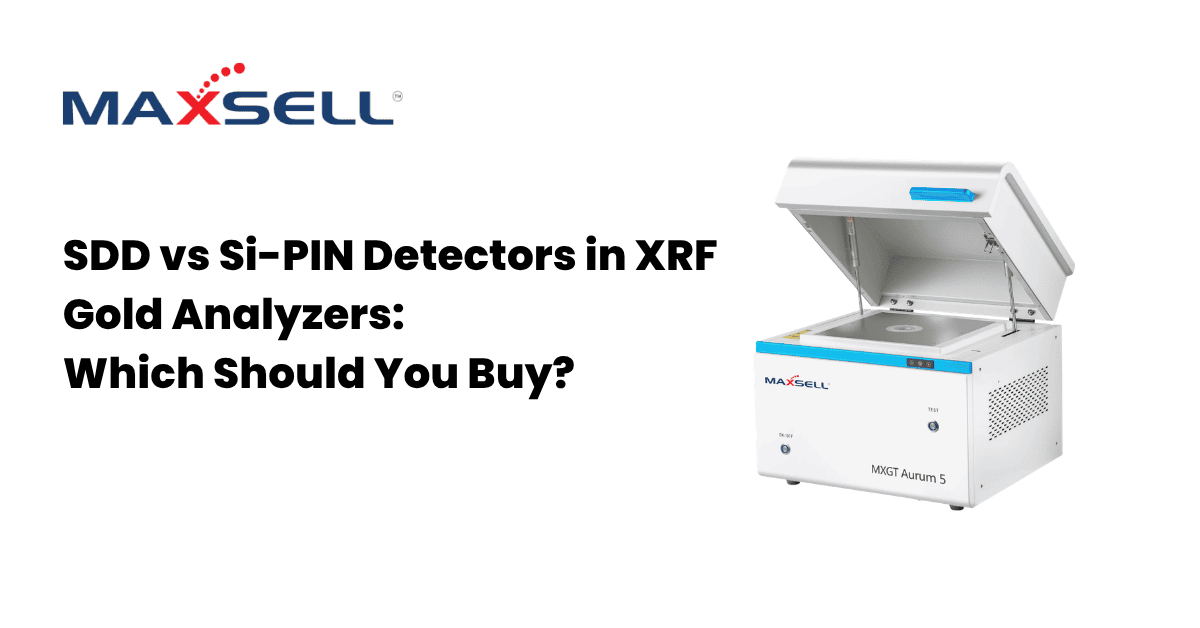
When evaluating an XRF Gold Testing Machine, one specification often dominates sales discussions:
SDD Detector or Si-PIN Detector?
Many buyers assume that choosing an SDD detector automatically guarantees superior gold testing performance. In reality, detector technology is important—but it is only one part of the analytical system. The smarter question is: Which detector is right for your application and budget? Let’s separate marketing from practical reality.
What Does the Detector Actually Do?
In an XRF Gold Analyzer, the detector captures fluorescent X-rays emitted by the sample after excitation by the X-ray tube.
The detector then converts these signals into electrical data, which the software uses to determine the concentration of gold and other elements.
Think of it this way:
- X-Ray Tube = Light Source
- Detector = Eyes of the Instrument
- Software = Brain of the Instrument
A stronger detector can improve performance, but it cannot compensate for poor optics, weak software, or inadequate calibration.
Understanding Si-PIN Detectors
Si-PIN (Silicon PIN Photodiode) detectors were the industry standard for many years.
Thousands of jewellery stores around the world still rely on Si-PIN based XRF analyzers every day.
Advantages of Si-PIN
- Lower acquisition cost
- Proven technology
- Stable long-term performance
- Excellent for routine gold purity testing
- Good return on investment
Limitations of Si-PIN
- Lower count rates
- Slower signal processing
- Lower energy resolution than SDD
- Less effective for highly complex elemental separation
For most jewellery retailers testing standard gold alloys, a modern Si-PIN detector can still deliver highly reliable results.
Understanding SDD Detectors
SDD stands for Silicon Drift Detector.
This technology was developed to improve signal collection efficiency and energy resolution.
Today, many premium XRF analyzers use SDD detectors because they can process significantly more information in less time.
Advantages of SDD
- Higher count rates
- Better energy resolution
- Faster analysis
- Improved elemental separation
- Better performance on challenging alloys
- Suitable for advanced analytical applications
Limitations of SDD
- Higher machine cost
- Higher replacement cost
- Performance advantage may not always be noticeable in routine jewellery testing
SDD vs Si-PIN: Comparison Table
| Feature | Si-PIN Detector | SDD Detector |
|---|---|---|
| Purchase Cost | Lower | Higher |
| Technology Generation | Mature | Advanced |
| Count Rate | Moderate | High |
| Energy Resolution | Good | Better |
| Analysis Speed | Fast | Faster |
| Complex Alloy Analysis | Good | Excellent |
| Retail Jewellery Testing | Excellent | Excellent |
| Manufacturing QC | Good | Excellent |
| Hallmarking Applications | Suitable | Excellent |
| Research Applications | Limited | Preferred |
The Most Important Truth Buyers Miss
Many buyers focus entirely on detector specifications.
However, detector technology alone does not determine analytical performance.
A gold analyzer’s accuracy also depends on:
- X-ray tube quality
- Optical geometry
- Filters and collimators
- Detector electronics
- Calibration standards
- Fundamental Parameter algorithms
- Software processing capability
In real-world testing, a well-designed Si-PIN analyzer can outperform an average SDD analyzer.
This is why experienced buyers compare complete systems rather than a single specification.
Which Detector Should You Choose?
Choose a Si-PIN XRF Analyzer If:
- You operate a jewellery retail store
- You mainly test gold ornaments
- You want excellent value for money
- Your focus is day-to-day gold purity verification
- Budget is an important consideration
Choose an SDD XRF Analyzer If:
- You operate a hallmarking centre
- You are a jewellery manufacturer
- You perform high-volume testing
- You analyze complex alloys regularly
- You want the highest analytical capability available
How Maxsell Approaches Detector Technology
At Maxsell, we believe the best detector is the one that matches the application.
That is why our portfolio includes both advanced Si-PIN and SDD-based XRF Gold Testing Machines.
More importantly, every system is designed as a complete analytical platform incorporating:
- Advanced X-ray optics
- FP 2.0 analytical algorithms
- Precision calibration
- AERB-compliant safety architecture
- High-performance software
- Long-term service support
The result is not just a better detector, but a better analyzer.
Final Verdict
If maximum analytical performance is your primary objective and budget is secondary, an SDD detector is generally the more advanced option.
However, that does not automatically make a Si-PIN analyzer the wrong choice.
For many jewellery retailers, gold buyers, and daily testing applications, a high-quality Si-PIN based XRF analyzer offers an excellent balance of performance, reliability, and investment.
The best buying decision is not choosing the most expensive detector.
It is choosing the XRF Gold Analyzer that delivers the level of confidence your business actually needs.
Because in gold testing, the detector matters.
But the overall engineering of the analyzer matters even more.